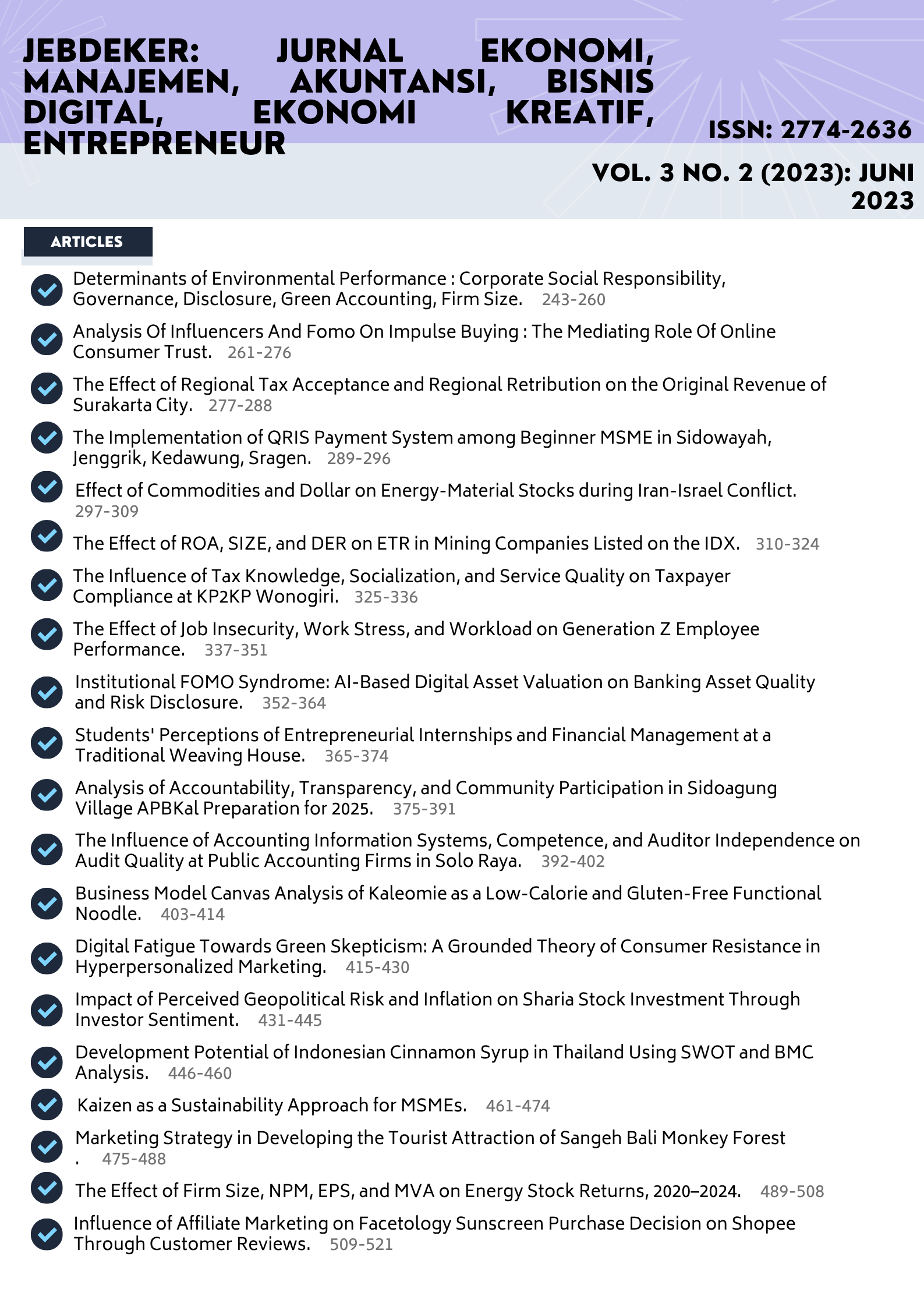
Students' Perceptions of Entrepreneurial Internships and Financial Management at a Traditional Weaving House
DOI:
https://doi.org/10.56456/jebdeker.v6i2.960Keywords:
Students’ Perceptions, Entrepreneurial Internship, Financial Management, Weaving HouseAbstract
The rapid development of the modern era offers both conveniences and various challenges related to human needs in life. This issue has received attention from higher education institutions as formal learning environments that strive to integrate theory and practice in order to produce graduates with entrepreneurial skills. This study aims to examine students’ perceptions of entrepreneurial internship experiences and financial management at Jo La Terre Weaving House, a weaving business based on local cultural values. The method employed in this study is a descriptive qualitative approach, which aims to provide an in-depth explanation of students’ perceptions regarding entrepreneurial internships and financial management at Jo La Terre Weaving House. Data were collected through observation, interviews, and documentation involving four female students as research subjects. The data analysis techniques used consisted of data reduction, data presentation, and conclusion drawing. The findings of this study reveal that internships are perceived as a learning medium and interpreted as opportunities to acquire new skills, such as learning the weaving process, gaining new knowledge, and developing entrepreneurial attitudes, including innovativeness, creativity, perseverance, and independence, directly in the internship setting. Other findings indicate that students understand the importance of business financial management skills, learn how to establish new businesses, develop cooperation, and foster an interest in entrepreneurship. The results of this study indicate that entrepreneurial internships and financial management can assist students in applying theories learned at university, developing new skills, and acquiring new knowledge regarding the tasks and responsibilities carried out during the internship experience.
References
Aas, I. T. B. (2024). Pengelolaan Keuangan Keluarga dan Faktor-Faktornya . 5, 131–141.
Anggraeni, D. (2024). Pengembangan Strategi Pemasaran Inovatif Untuk Memperluas Pasar Produk Citul Mantul Melalui Program Magang Wirausaha Merdeka. 1(2).
Anwar, R. N. (2022). PERSEPSI GURU PAUD TERHADAP PEMBELAJARAN PARADIGMA BARU MELALUI KURIKULUM MERDEKA.
Armelitta, A., Nursyahrani, A., Amalia, N. S., Ashfiya, R., & Nursahwa, S. (2025). Analisis Peran Sikap Kewirausahaan dalam Mengoptimalkan Peluang Digital. 4, 6120–6131.
Bachtiar, I. Y., & Faridatussalam, S. R. (2024). Pengembangan Semangat Wirausaha pada Industri Pariwisata di Kalangan Generasi Muda Melalui Program Magang Wirausaha Merdeka. Jurnal Pengabdian Masyarakat Inovasi Indonesia, 2(1), 177–182. https://doi.org/10.54082/jpmii.351
Bidin, C. R. K., Natsir, S., Adda, H. W., Putu, N., Rossanti, E., & Santi, I. N. (2024). dan Menengah ( UMKM ) Dalam Pengelolaan Keuangan Dan Pemasaran Berbasis Digital Dipesisir Pantai Desa Masaingi Enhancing Human Resources ( HR ) for Micro , Small , and Medium Enterprises ( MSMEs ) Competencies in Financial Management and Digital-Based Mar. 3(2), 207–213.
Chayo, E. D., Febriandika, N. R., Aji, N. P., Ramadhan, M. H., Islam, F. A., Surakarta, M., Studi, P., Ekonomi, H., Islam, F. A., Muhammadiyah, U., Akuntansi, P. S., Muhammadiyah, U., Islam, F. A., & Surakarta, M. (2022). WIRAUSAHA MERDEKA : PEMBERDAYAAN MAHASISWA MELALUI PROGRAM WIRAUSAHA. 3, 222–229.
Islam Indragiri, U., Astuti, S., Fajar Susanto, B., Kunci, K., Magang, P., Berwirausaha, K., Kuantitatif, S., & Linear, R. (2025). Digital Business Insights Journal PENGARUH PENGALAMAN MAGANG TERHADAP KESIAPAN BERWIRUSAHA MAHASISWA A R T I C L E I N F O A B S T R A K (Vol. 1, Number 1).
Juliyanti, W., Adamura, F., Jianggimahastu, P., & Husaini, R. (2025). Peningkatan Literasi Keuangan UMKM melalui Sosialisasi Pemisahan Keuangan Usaha dan Pribadi di Desa Jatirejo , Wonoasri ,. 3(9), 5046–5052.
Muhammad Dinar, M. Ihsan Said Ahmad, & Muhammad Hasan. (2020). KEWIRAUSAHAAN.
Napitupulu, J. H., Ellyawati, N., & Astuti, R. F. (2021). PENGELOLAAN KEUANGAN MAHASISWA KOTA SAMARINDA. 9(3).
Nisa, A. H. H. Y. (2023). Persepsi. KOLONI: Jurnal Multidisiplin Ilmu, Vol.2, No.4, 213–226.
Nuraini, U. (2025). MENGGALI MAKNA KEWIRAUSAHAAN DALAM PENDIDIKAN AKUNTANSI : PERSPEKTIF MAHASISWA AM TERHADAP KURIKULUM MBKM DAN SDG 8. 13(3), 303–314.
Rahmat Mahmudi, A., Suryadi, A., & Ibrahim, N. (2025). Persepsi Mahasiswa dalam Pembelajaran Mata Kuliah Kewirausahaan Pada Program Studi Pendidikan Sejarah Universitas Negeri Semarang. In Didaktika: Jurnal Kependidikan (Vol. 14, Number 1). https://jurnaldidaktika.org
Rondli, W. S., Wijayanto, W., Fathurohman, I., & Vannesicha, Y. (2024). Penguatan Jiwa Entrepreneurship Dalam Pendidikan Kewarganegaraan Melalui Penjualan Alat Musik Gamelan. 3(6), 8855–8862.
Safarudin, R., Kustati, M., & Sepriyanti, N. (2023). Penelitian Kualitatif. 3, 9680–9694.
Siboro, C. H. (2025). PEMBAYARAN UTANG USAHA PADA PT INTIDAYA DINAMIKA SEJATI. 3(10), 133–141.
Sudiantini, D., Suryadinata, A., Rahayu;, A. S., Aprilia, A. B., & Lestari, A. D. (2023). Ruang Lingkup Manajemen Keuangan Scope Of Financial Management. 1(3), 60–65.
Wirausaha Mahasiswa Waddi Fatimah, E. (2025). Kolaborasi Perguruan Tinggi Dengan Dunia Usaha Dan Industri Dalam Pengembangan. In Jurnal Pendas Mahakam (Vol. 10, Number 2).
Wulandari, D. F., & Siregar, Q. R. (2025). Mandiri : Jurnal Akuntansi dan Keuangan Pengaruh Literasi Keuangan Dan Kesadaran Keuangan terhadap Pendahuluan. 4(1).